On October 27 at the Rokid Jungle 2026 launch event, Rokid unveiled three new products: the Rokid Glasses 2, Rokid Color, and Rokid Ring, pushing the interaction boundaries of AI glasses from full-color display to micro-gesture control. As the flagship for everyday use, the Rokid Glasses 2 received comprehensive upgrades across lightweight design, optical display, first-person imaging, battery life, and AI interaction. The goal is to lower the barrier to entry so the glasses feel comfortable for all-day wear and blend naturally into every corner of daily life.
By Wickey, VR Gyro For AI glasses, there is only one truly serious question — how to enter everyday life. On October 27, at the Rokid Jungle 2026 new product launch event, Rokid officially unveiled three new products: the Leqi AI Glasses Gen 2, Rokid Color, and Rokid Ring. From full-color display to micro-gesture interaction, Rokid is attempting to expand the interaction boundaries of AI glasses, making the acquisition and manipulation of digital information more natural. Among them, as the flagship product for everyday use, the Leqi AI Glasses Gen 2's upgrade is more comprehensive and closer to daily life. The Leqi AI Glasses Gen 2 has been comprehensively optimized around lightweight design, optical display, first-person imaging, battery life and AI interaction, further lowering the barrier to use and letting AI glasses blend more naturally into every aspect of life. More invisible gratings, more natural fit: all-day wearing without strain AI glasses must first and foremost be a pair of glasses people are willing to wear out the door, glasses that fit naturally into daily life — and the Leqi AI Glasses Gen 2 is a product continuously refined in exactly that direction. The Leqi AI Glasses Gen 2 continues the previous generation's clean, restrained design language while optimizing details such as the frame, temples and nose pads. The new generation adopts a square-round frame design, available in two colors: black and tortoiseshell; the black version was used for this hands-on review. Image source: VR Gyro Compared with the previous generation, the frame lines are more rounded, the raised touch area has been removed, and the whole unit is smoother — wearing it out in daily life does not look out of place. In the wearing structure, the new model adopts flexible temple arms that better adapt to different users' head contours. Image source: VR Gyro Meanwhile, the nose pads are made of medical-grade silicone — skin-friendly and unlikely to cause allergies — with a further increased contact area that distributes the load on the bridge of the nose more evenly, reducing localized pressure and improving long-wearing comfort. Image source: VR Gyro Achieving all-day wear also requires accommodating usage needs across different scenarios. The whole unit supports IPX4 water resistance, handling everyday sweat and rain splashes, and Rokid Care warranty service is provided to further reduce everyday worries. The Leqi AI Glasses Gen 2 supports a magnetic myopia lens frame and sunglass clips, meeting nearsighted users' vision-correction needs while adapting to bright outdoor environments and sparing users the trouble of frequently switching glasses. Image source: Leqi Rokid While integrating display, photography and AI interaction, the Leqi AI Glasses Gen 2 also maintains a lightweight design. It continues the "one-source, two-eye" optical architecture, pairing a single-green Micro-LED light engine with binocular waveguides, freeing up more space for components such as the camera and battery. At the same time, the optical engine bump at the nose bridge is about 30% smaller than the previous generation and about 1mm shorter, making the overall structure more compact. Image source: VR Gyro Another key to the Leqi AI Glasses Gen 2's natural fit into everyday wear is the improvement in lens transparency. According to official information, the new model achieves these gains through full-domain ultra-low-reflectivity coating and nanoscale groove texturing and other process optimizations: reflectivity is down 70%, and grating coupling efficiency is up 30%. In actual experience, the grating marks are almost imperceptible at normal social distance — only by tilting the lens about 45 degrees can they be observed from specific angles. Image source: VR Gyro Thanks to the optimized coating process and nanoscale groove texture design, the rainbow pattern problem common to diffractive waveguides is also well controlled. Whether under complex indoor lighting, strong midday outdoor sunlight, or nighttime lighting, the lenses showed no rainbow patterns or stray light noticeably affecting vision; the overall visual experience is fairly natural and can satisfy daily multi-scenario wearing needs. For display, the Leqi AI Glasses Gen 2's maximum brightness to the eye is 1,500 nits, with the display area located in the lower-center of the lens, so information can be retrieved without deliberately adjusting one's gaze. Meanwhile, the built-in ambient light sensor supports adaptive brightness adjustment. In testing, even under strong daytime outdoor sunlight, text edges remained clear with no obvious pixelation, and information such as navigation and translations showed good readability. Outdoor daylight environment; phone shot slightly out of focus, the actual effect is better. Image source: VR Gyro Dual chips, dual systems: completing the foundational all-day experience To move AI glasses from occasional use to high-frequency use, stable performance, reliable battery life and a clear audio experience are equally indispensable. First, on the chip side, the Leqi AI Glasses Gen 2 carries a dual-chip setup of the new-generation Snapdragon AR1+ platform and Bestechnic's BES2800BP, running Android and RTOS as dual systems. Through an underlying intercommunication mechanism, both systems can access core peripherals such as interaction, Bluetooth and display, scheduling flexibly according to task needs to balance performance and power consumption. Image source: Leqi Rokid A major advantage of the dual-chip architecture is power management: assigning tasks on demand reduces unnecessary energy consumption, which effectively extends the device's battery life. The Leqi AI Glasses Gen 2 also uses a silicon-anode battery with stacked-cell construction, raising capacity by 25% to 263mAh. To verify real-world battery life, we separately ran tests of continuous video recording, photo shooting, audio playback and daily mixed use; the specific power consumption is as follows: Data measured at room temperature; actual battery life varies with environment and usage, for reference only. Image source: VR Gyro Taken together, under light daily mixed use, the Leqi AI Glasses Gen 2 lasts about 9 hours, basically covering an entire day. For charging, the new model continues the magnetic charging design; in testing, charging from 0% to 75% took about 20 minutes. For those still anxious about battery life, an optional 335mAh capsule battery offers 14% higher charging efficiency. According to official information, the charging case paired with a fully charged capsule can replenish the glasses about 6 times, further easing battery anxiety. Beyond power management, the dual-chip architecture also supports voice interaction. When the user says the wake word "Leqi," keyword recognition can be handled by the low-power chip, with compute scheduled on demand once AI Q&A begins. In actual testing, with a good network connection, we made 10 consecutive voice queries: average wake-up response time was about 0.3 seconds, and answers took about 3.2 seconds — overall interaction was quite smooth. Of course, voice interaction must not only respond quickly, but also accurately hear the user's commands. To this end, the Leqi AI Glasses Gen 2 adopts a through-type wind-noise-resistant microphone structure, paired with 4 omnidirectional microphones and 1 bone-conduction microphone, with a focus on improving voice pickup amid outdoor wind noise and soft conversation. Image source: Leqi Rokid On audio, the new model upgrades the AAC speaker units and has passed Dolby certification, with optimizations for low-frequency and mid-to-high-frequency performance. In a relatively quiet indoor setting, around 10% volume already sounds quite good; even in fairly noisy outdoor environments, speech content is clearly audible at about 50% volume. Flagship-grade optical lens group + 4K imaging: Rokid plays first-person shooting in new ways Recording the wonderful moments in front of you anytime, anywhere is an important scenario for AI glasses entering daily life, and the Leqi AI Glasses Gen 2 further makes first-person shooting simpler and more controllable. On the hardware side, the Leqi AI Glasses Gen 2 packs a flagship-smartphone-grade optical lens group directly into the glasses. According to official information, the new model adopts a 1GM5P glass-plastic hybrid lens group for the first time and carries a 12-megapixel OV12M HDR CMOS sensor supporting RAW14 output. The higher-spec optical configuration provides more headroom for light intake, image resolution and noise control, making night and low-light shooting all the more promising. Image source: Leqi Rokid In the past, shooting with AI glasses was a bit like film photography: before reviewing the shots, it was hard to judge the final composition, and problems like subject drift and unwanted cropping were common. The newly added "pre-shot preview" feature on the Leqi AI Glasses Gen 2 addresses exactly this pain point. Using the lens display system, users can confirm the subject's position and shooting range in advance and adjust composition in time. In actual experience, the preview image is basically in sync with the camera's viewfinder with virtually no perceptible latency, and users can also choose to display only the framing outline to avoid blocking their view. Phone shot, for feature demonstration only; the actual experience is better. Image source: VR Gyro Beyond more controllable composition, snapshot speed has also improved. The Leqi AI Glasses Gen 2's shutter response is 100% faster than the previous generation, better capturing fleeting moments. As for shooting specs, the new model supports 4K portrait and 3K landscape shooting, covering recording and sharing needs across different scenarios. Outdoor and indoor low-light samples. Image source: VR Gyro In actual experience, the Leqi AI Glasses Gen 2's imaging really holds up. In well-lit outdoor environments, images are clear and transparent, architectural details are sharp, and colors are vivid; even in indoor scenes with insufficient and intermingled light and shadow, it balances exposure and detail retention fairly well. Meanwhile, thanks to its proprietary imaging algorithms, the Leqi AI Glasses Gen 2 is optimized for different lighting environments and portraits, with particular attention to highlight suppression and shadow detail retention in backlit scenes. Its super night algorithm also performs frame-by-frame denoising on video, mitigating the noise and detail loss common in night shooting. Backlit and night samples. Image source: VR Gyro From the actual samples, the Leqi AI Glasses Gen 2 performs excellently in complex lighting and night environments. In daytime backlit scenes, bright and dark details are fairly completely preserved; at night, overall exposure control is stable, color reproduction is natural, and highlight suppression and shadow detail are fairly well balanced, with only a small amount of noise in extremely dark areas. For video, the Leqi AI Glasses Gen 2 provides richer recording specs, supporting 4K 30fps and 2K 60fps — the former emphasizing picture detail, the latter better suited to dynamic scenes such as sports. In addition, 720p 120fps slow-motion shooting is planned to be opened via OTA later, so moments like jumps, racket swings and running pets can be presented more expressively. Video samples, quality compressed by the platform; the actual experience is better. Video source: VR Gyro Judging from the video samples: in ample daylight, colors are vivid, details of buildings and surroundings are well preserved, and the overall look is fairly natural. In night scenes, some highly lit signboards and light sources inevitably overexpose, but overall exposure and picture stability still perform well. In particular, in sample two's nighttime cycling scene, even facing constant road vibration and head movement, picture shake remains within a reasonable range, demonstrating solid first-person stabilization. From pre-shot preview and faster shutter response to night and stabilization optimizations, Rokid's imaging upgrades this time focus more on the actual shooting experience, and left us feeling that AI glasses are gradually shifting from simply chasing "point-and-shoot" toward improving output quality and shooting controllability. Navigates, records, and understands you better: the Leqi AI Glasses Gen 2 becomes a portable AI assistant During this period of experience, our deepest impression was that the Leqi AI Glasses Gen 2 has begun integrating into every scenario of life and work — many things that once required a phone can now be handled directly by the glasses. On the commute, navigation information appears right before your eyes, no need to keep looking down at your phone; when giving a report, the glasses can serve as a teleprompter for a more confident delivery; when a temporary to-do or a sudden idea comes up, just say it aloud and it can be handed to the AI to record. Feature demonstrations; phone shots or screen recordings, the actual experience is better. Image source: VR Gyro The Rokid Ring released at the same time also brings a new interaction method to the Leqi AI Glasses Gen 2. Paired with the Rokid Ring, users need only gently slide their thumb against their index finger to complete app switching, page turning and other operations; single or double taps can be used for confirm and back; volume can be adjusted with a rotation gesture, and custom gesture commands are supported. Image source: Leqi Rokid Compared with voice and temple touch controls, this micro-gesture interaction feels more natural in public. For example, while commuting on the subway you can skip songs or turn pages without raising your hand, and in meetings you can control the glasses with subtle movements, reducing the disruption caused by voice commands. In addition, finger-snap photo, video and recording functions give first-person recording one more fun way to operate. In office scenarios, the Leqi AI Glasses Gen 2 can combine first-person shooting with audio recording: during meetings you can casually capture key information such as slides and charts, and AI then generates illustrated minutes, extracting key points and to-do items, saving a good deal of post-meeting organizing effort. Image source: VR Gyro For users working or traveling across borders, the Leqi AI Glasses Gen 2 supports real-time interpretation in 89 languages, with subtitles displayed directly on the lenses, making it easy to order food, ask for directions and communicate across languages. In addition, AI call translation and voice cloning are planned to be opened gradually via OTA later, further expanding cross-language communication. Another impression the Leqi AI Glasses Gen 2 gave us is that it is becoming more like a personal assistant you carry with you. Unlike the AI assistants of the past, which required repeated wake-ups and questions, Rokid has begun trying to give the glasses longer-term memory, accumulating more contextual information with use and gradually learning the user's habits and needs. Image source: VR Gyro We had previously casually mentioned to the AI that we like coconut chicken. Later, passing Shenzhen Huangting Plaza, we asked "what's good to eat nearby?" — it combined our preferences and recommended nearby restaurants such as Jiangnan Yelin Coconut Chicken, thoughtfully listing floor locations and cuisine suggestions. Compared with simple information retrieval, this kind of interaction that combines personal preferences with the current context to offer suggestions made us look forward even more to AI glasses' long-term memory and proactive assistance. The "AI All-Day Recall" and "AI Instant Recall" features Rokid plans to open via later OTA can organize information such as daily conversations and important matters. When users forget what was discussed before, or want to revisit details from a past exchange, they can ask the AI directly. Users can also customize the wake word, AI shortcut commands and more, making interaction better fit personal habits. Beyond the AI capabilities themselves, the Leqi AI Glasses Gen 2's open ecosystem is also worth mentioning. For model choice, users can switch between large models such as Qwen, Doubao, DeepSeek and Zhipu according to their needs, and the agent store further expands the glasses' applications in office work, entertainment, travel and other fields. Image source: VR Gyro For office work, Rokid has already partnered with agents such as Tencent WorkBuddy and Alibaba Qoder; users can remotely launch document processing, data organization, coding and other tasks through the glasses, and check execution progress. Meanwhile, Qwen Office has further expanded its document-writing capabilities and is exploring collaboration with office platforms such as DingTalk. Image source: VR Gyro For lifestyle services, Rokid continues to expand its third-party ecosystem: it already supports Alipay's "Look and Pay" and WeChat scan-to-pay, and has partnered with Meituan, Xiaohongshu, Tencent Mobility and other platforms, covering scenarios such as takeout reminders, scan-to-collect meals, content browsing and AI ride-hailing. In addition, SMZDM's "Zhang Dama" agent can assist shopping decisions; the company is exploring more applications with ecosystem partners such as EverMind and Fun Pizsa; and sports agents such as Running Master and Cycling Master provide information tips and assisted guidance during workouts. Notably, Rokid has also launched Rokid Prism, a desktop agent connector, letting the glasses link with desktop agents such as Codex and Hermes to check task progress, receive feedback and handle key confirmation items, without having to stay glued to the computer. As the third-party ecosystem continues to enrich, Rokid's AI glasses are also evolving from an information-display and voice-interaction tool into a portable intelligent terminal that can connect multiple services and assist in executing tasks. Closing thoughts At the start of this article, we borrowed Camus's classic phrasing from The Myth of Sisyphus to reduce AI glasses' truly serious question to one thing — how to enter everyday life. After this stretch of experience, that question seems to have a more concrete answer. The Leqi AI Glasses Gen 2 is no longer confined to demonstrating what technology can do: a navigation glance on the commute, a casual record on a trip, information captured in a meeting — these seemingly insignificant moments are gradually turning AI glasses into a usage habit. Of course, capabilities such as long-term memory and proactive assistance still need refinement, and Rokid still has a long way to go from its ideal personal AI terminal. But with the addition of Rokid Color and Rokid Ring, we have also seen the possibility of further fusing display, sensing and interaction.
文/VR陀螺 Wickey 对于AI眼镜而言,真正严肃的问题只有一个——如何进入生活。10月27日,在Rokid Jungle 2026 乐奇AI眼镜新品发布会上,乐奇Rokid正式推出乐奇AI眼镜二代、Rokid Color及Rokid Ring三款新品。从全彩显示到微手势交互,乐奇Rokid正在尝试拓展AI眼镜的交互边界,让数字信息的获取与操作变得更加自然。其中,作为面向日常使用的主力产品,乐奇AI眼镜二代的升级可以说更加全面,也更加贴近生活。
乐奇AI眼镜二代围绕轻量化设计、光学显示、第一视角影像、续航性能及AI交互进行了全面优化,进一步降低使用门槛,让AI眼镜更自然地融入生活的方方面面。光栅更隐形、佩戴更自然,乐奇AI眼镜二代全天佩戴无压力 AI眼镜首先得是一副让人愿意戴出门、能够自然融入日常生活的眼镜,而乐奇AI眼镜二代正是朝着这一方向持续打磨的产品。乐奇AI眼镜二代延续了前代简洁克制的设计语言,同时对镜框、镜腿及鼻托等细节进行了优化。
新一代产品采用方圆框型设计,提供黑色与玳瑁色两种配色,陀螺君此次上手体验的是黑色版本。图源:VR陀螺 相比上一代,镜框线条更加圆润,触控区域取消凸起,整体更加平滑。日常佩戴出门也不会显得突兀。在佩戴结构上,新款采用柔性镜腿设计,能够更好地适应不同用户的头部轮廓。图源:VR陀螺 同时,鼻托采用医用级硅胶,亲肤且不易引起过敏,接触面积也进一步增大,能够更均匀地分散鼻梁受力,减轻局部压迫感,提升长时间佩戴的舒适度。
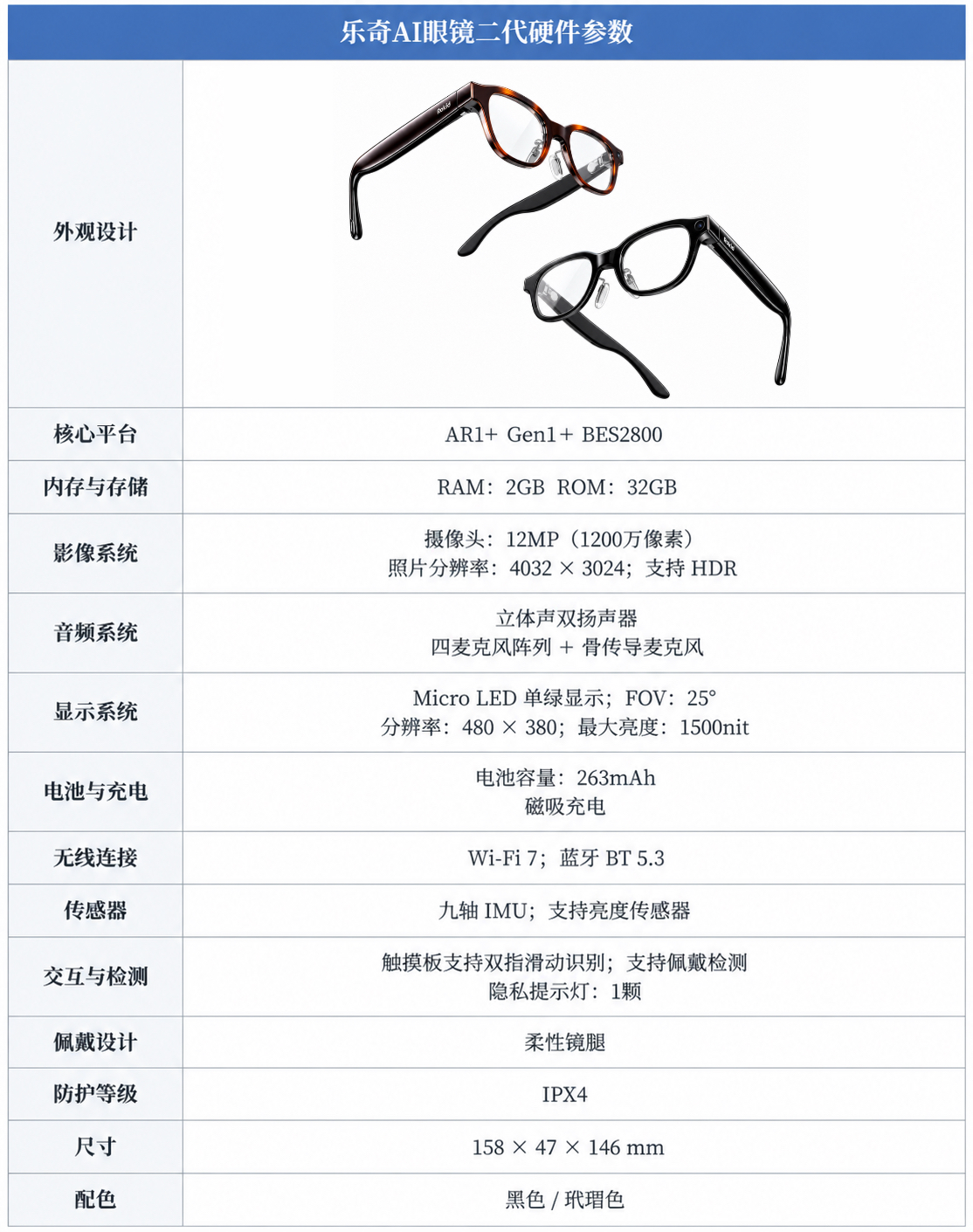
图源:VR陀螺 要实现全天候佩戴,还需要兼顾不同场景下的使用需求。整机支持IPX4级防水,可应对日常汗水及雨水泼溅,并提供Rokid Care保障服务,进一步降低日常使用的顾虑。乐奇AI眼镜二代支持磁吸近视镜架与墨镜夹片,既能满足近视用户的视力矫正需求,也能适应户外强光环境,减少频繁更换眼镜的麻烦。图源:乐奇Rokid 乐奇AI眼镜二代在集成显示、拍摄及AI交互等功能的同时,兼顾了轻量化设计。其延续的“一拖二”光学架构,通过单绿Micro-LED光引擎搭配双目光波导,为摄像头、电池等元器件腾出更多空间。
同时,鼻梁处的光机凸起较前代缩小约30%,长度缩短约1mm,整机结构更加紧凑。图源:VR陀螺 乐奇AI眼镜二代能够自然融入日常佩戴,另一关键在于镜片通透性的提升。据官方介绍,新款通过全域超低反射镀膜及纳米级沟槽纹理等工艺优化,反射率下降70%,耦入光栅效率提高30%。实际体验中,光栅痕迹在正常社交距离下几乎难以察觉,只有将镜片倾斜约45°,从特定角度才能观察到。图源:VR陀螺 得益于镀膜工艺与纳米级沟槽纹理设计的优化,衍射光波导常见的彩虹纹问题也得到了较好控制。
无论是室内复杂光源、户外正午强光,还是夜间灯光环境下,镜片均未出现明显影响视线的彩虹纹或杂散光,整体视觉体验较为自然,能够满足日常多场景下的佩戴需求。显示方面,乐奇AI眼镜二代最大入眼亮度为1500nit,显示区域位于镜片中央偏下位置,无需刻意调整视线即可获取信息。同时,内置环境光传感器支持亮度自适应调节。实测中,即使在日间户外强光下,文字边缘依然清晰,像素颗粒感不明显,导航、翻译等信息均具有较好的可读性。
户外日光环境,手机拍摄略微虚焦,实际效果更佳。图源:VR陀螺 双芯双系统,乐奇AI眼镜二代补齐全天佩戴的基础体验 要让AI眼镜从偶尔使用走向高频使用,稳定的性能、可靠的续航与清晰的音频体验同样不可或缺。首先是芯片方面,乐奇AI眼镜二代搭载新一代骁龙AR1+平台与恒玄BES2800BP双芯片,分别运行Android与RTOS双系统。通过底层互通机制,两套系统均可访问交互、蓝牙及显示等核心外设,并根据任务需求灵活调度,兼顾性能与功耗。
图源:乐奇Rokid 双芯架构的一大优势在于功耗管理,通过按需分配任务减少不必要的能耗,这能有效延长设备续航。同时乐奇AI眼镜二代采用硅负极电池与叠片工艺,容量较前代提升25%至263mAh。为验证实际续航,陀螺君分别进行了连续录像、拍照、音频播放及日常混合使用测试,具体耗电情况如下: 数据于常温环境下测得,实际续航因环境及使用情况而异,仅供参考。图源:VR陀螺 综合测试来看,在日常轻度混合使用下,乐奇AI眼镜二代续航约为9小时,基本能够覆盖一整天。
充电方面,新款延续磁吸充电设计,测试中从0%充至75%耗时约20分钟。如果仍有续航焦虑官方还推出了容量335mAh的胶囊电池,充电效率提升14%。据官方介绍,充电盒搭配满电胶囊可为眼镜补充约6次电量,进一步缓解续航压力。除了功耗管理,双芯架构也为语音交互提供了支持。用户说出唤醒词“乐奇”时,关键词识别可由低功耗芯片完成,进入AI问答后再按需调度算力。实际测试中,在网络良好的情况下,陀螺君连续进行了10次语音提问,平均唤醒响应时间约0.3秒,问题回复耗时约3.2秒,整体交互较为流畅。
当然,语音交互不仅要响应快,还得能够准确听清用户的指令。为此,乐奇AI眼镜二代采用贯穿式麦克风防风噪结构,搭配4颗全向麦克风与1颗骨传导麦克风,着重改善户外风噪及轻声交谈时的语音拾取效果。图源:乐奇Rokid 音频方面,新款升级了AAC扬声器单元,并通过杜比认证,对低频及中高频表现进行了优化。在相对安静的室内,10%左右的音量便有不错的听感;即使在较为嘈杂的户外,约50%的音量也能清晰听到语音内容。
旗舰级光学镜片组+4K影像,乐奇Rokid把第一视角拍摄玩出了新花样 随时随地记录眼前的精彩瞬间,是AI眼镜融入生活的重要场景,而乐奇AI眼镜二代进一步让第一视角拍摄变得更加简单、可控。硬件方面,乐奇AI眼镜二代直接将旗舰手机级的光学镜片组塞进了眼镜。据官方介绍,新款首次采用1GM5P玻塑混合镜片组,并搭载1200万像素OV12M HDR CMOS传感器,支持RAW14输出。更高规格的光学配置为进光量、画面解析力及噪点控制提供了更大空间,也让夜景与暗光拍摄有了更值得期待的表现。
图源:乐奇Rokid 过去,AI眼镜拍摄有点像胶片摄影,在查看成片之前,很难判断最终的构图效果,容易出现主体偏移、画面裁切等问题。乐奇AI眼镜二代新增的“拍前预览”功能,恰好改善了这一痛点。借助镜片显示系统,用户可以提前确认主体位置与拍摄范围,及时调整构图。实际体验中,预览画面与摄像头取景基本同步,几乎感受不到延迟,同时还可选择仅显示取景轮廓,避免遮挡视野。手机拍摄,仅作功能演示,实际体验更佳。图源:VR陀螺 除了构图更可控,抓拍速度也有所提升。
乐奇AI眼镜二代的快门响应速度较前代提升100%,能够更及时地捕捉转瞬即逝的画面。拍摄规格方面,新款支持4K竖屏与3K横屏拍摄,兼顾不同场景下的记录与分享需求。户外及室内暗光环境效果。图源:VR陀螺 实际体验下来,乐奇AI眼镜二代的成像表现确实很能打。在户外光线充足的环境下,画面通透,建筑细节清晰,色彩鲜明;即使在室内光线不足、明暗交错的场景中,也能较好地兼顾曝光与细节保留。同时,得益于自研成像算法,乐奇AI眼镜二代针对不同光照环境与人像进行了优化,尤其注重逆光场景下的高光压制与暗部细节保留。
同时,超级夜景算法能够对视频画面逐帧降噪,改善夜间拍摄时容易出现的噪点与细节丢失问题。逆光与夜景拍摄效果。图源:VR陀螺 从实拍样张来看,乐奇AI眼镜二代在复杂光源和夜景环境下表现优异。日间逆光场景中,明暗细节保留较为完整;夜景下整体曝光控制稳定,色彩还原自然,高光压制与暗部细节表现也较为均衡,仅在极暗区域存在少量噪点。视频方面,乐奇AI眼镜二代提供了更丰富的录制规格,支持4K 30fps与2K 60fps,前者侧重画面细节,后者则更适合运动等动态场景。
此外,后续还计划通过OTA开放720p 120fps慢动作拍摄,让跳跃、挥拍、宠物奔跑等瞬间能够以更具表现力的方式呈现。视频样片,画质平台压缩,实际体验更佳。视频源:VR陀螺 从视频样片来看,白天光线充足时,画面色彩鲜明,建筑与周围环境的细节保留较好,整体观感较为自然。夜景环境下,部分高亮灯牌与光源不可避免地出现过曝,但整体曝光与画面稳定性仍有不错的表现。尤其是样片二的夜间骑行场景,即使面对持续的路面颠簸与头部晃动,画面抖动依然控制在合理范围内,展现出较好的第一视角防抖能力。
拍前预览、快门提速到夜景与防抖优化,乐奇Rokid此次的影像升级更加注重实际拍摄体验,也让陀螺君感受到,AI眼镜正在从单纯追求“随手拍”,逐渐转向提升成片质量与拍摄可控性。能导航、会记录、更懂你,乐奇AI眼镜二代成为随身AI助理 在这段时间的体验中,陀螺君最深的感受,是乐奇AI眼镜二代已经开始融入生活与工作的各个场景,一些原本需要手机完成的事情,如今已经可以直接交给眼镜就能解决。通勤路上,导航信息直接呈现在眼前,无需频繁低头查看手机;
做汇报时,眼镜又能充当提词器,让表达更加从容;遇到临时待办或突然想到的事情,只需随口说一句,便能交给AI记录下来。部分功能演示,手机拍摄或录屏,实际体验更佳。图源:VR陀螺 此次同期发布的Rokid Ring,也为乐奇AI眼镜二代带来了新的交互方式。搭配Rokid Ring后,用户只需用拇指在食指上轻轻滑动,即可完成应用切换、翻页等操作,单击或双击可用于确认与返回,还能通过旋转手势调节音量,并支持自定义手势指令。
图源:乐奇Rokid 相比语音和镜腿触控,这种微手势交互在公共场合显得更加自然。例如,地铁通勤时可以不抬手完成切歌、翻页,会议中也能通过细微动作控制眼镜,减少语音指令带来的打扰。此外,响指拍照、录像及录音等功能,也让第一视角记录多了一种有趣的操作方式。而在办公场景中,乐奇AI眼镜二代能够将第一视角拍摄与音频记录结合,在会议过程中随手记录PPT、图表等关键信息,再由AI生成图文纪要、提炼重点及待办事项,省去不少后期整理的麻烦。
图源:VR陀螺 对于跨境办公或出行的用户,乐奇AI眼镜二代支持89种语言实时转译,字幕可直接显示在镜片上,方便点餐、问路及跨语言交流。此外,后续还计划通过OTA逐步开放AI通话翻译、音色克隆,进一步拓展跨语言沟通能力。乐奇AI眼镜二代带给陀螺君的另一个感受,是它正在变得更像一位随身的个人助理。相比过去需要反复唤醒、提问的AI助手,乐奇Rokid开始尝试让眼镜拥有更长期的记忆,随着使用积累更多上下文信息,逐渐了解用户的习惯与需求。
图源:VR陀螺 此前陀螺君曾随口向AI提过自己喜欢吃椰子鸡,后来经过深圳皇庭广场时,问了一句“附近有什么好吃的?”,它便结合我的偏好,推荐了江南椰林椰子鸡等周边餐厅,还贴心地列出了楼层位置与菜系建议。相比简单的信息检索,这种能够结合个人偏好与当前场景提供建议的交互,也让我对AI眼镜的长期记忆与主动辅助能力有了更多期待。乐奇Rokid计划通过后续OTA开放的“AI全天回溯”与“AI及时回溯”,能够对日常对话、重要事项等信息进行整理。
当用户忘记此前讨论过的内容,或者想回顾某次交流中的细节时,可以直接向AI询问。此外,用户还可以自定义唤醒词、AI快捷指令等,让交互更符合个人习惯。除了AI能力本身,乐奇AI眼镜二代的开放生态也值得一提。在模型选择上,用户可以根据需求切换通义千问、豆包、DeepSeek、智谱等大模型,智能体商店则进一步拓展了眼镜在办公、娱乐、出行等领域的应用。图源:VR陀螺 办公方面,乐奇Rokid已与腾讯WorkBuddy、阿里Qoder等智能体展开合作,用户可通过眼镜远程发起文档处理、数据整理及编程等任务,并查看执行进度。
同时,千问办公也进一步拓展了文档写作能力,并探索与钉钉等办公平台的协同。图源:VR陀螺 生活服务方面,乐奇Rokid持续拓展第三方生态,已支持支付宝“看一下支付”与微信扫一扫支付,并与美团、小红书、腾讯出行等平台合作,覆盖外卖提醒、扫码取餐、内容浏览及AI叫车等场景。此外,“什么值得买”张大妈智能体可辅助购物决策,还与EverMind、Fun Pizsa等生态伙伴探索更多应用,并通过跑步大师、骑行大师等运动智能体,为用户提供运动过程中的信息提示与辅助指导。
值得一提的是,乐奇Rokid还推出了Rokid Prism(棱镜)桌面智能体连接器,让眼镜能够与Codex、Hermes等桌面智能体联动,查看任务进度、接收反馈及处理关键确认事项,无需始终守在电脑前。随着第三方生态持续丰富,乐奇AI眼镜也开始从信息显示与语音交互工具,逐渐向能够连接多种服务、协助执行任务的随身智能终端演进。写在最后 文章开头,陀螺君借用了加缪在《西西弗神话》中的经典句式,将AI眼镜真正严肃的问题归结为——如何进入生活。
经过这段时间的体验,这个问题似乎有了更加具体的答案。乐奇AI眼镜二代已经不再局限于展示技术的可能性,通勤时的一次导航、旅途中的随手记录、会议上的信息整理,这些看似微不足道的瞬间,正在让AI眼镜逐渐成为一种使用习惯。当然,长期记忆、主动辅助等能力仍有待完善,乐奇Rokid距离理想中的个人AI终端还有很长一段路要走。但随着Rokid Color与Rokid Ring的加入,我们也看到了显示、感知与交互进一步融合的可能。