

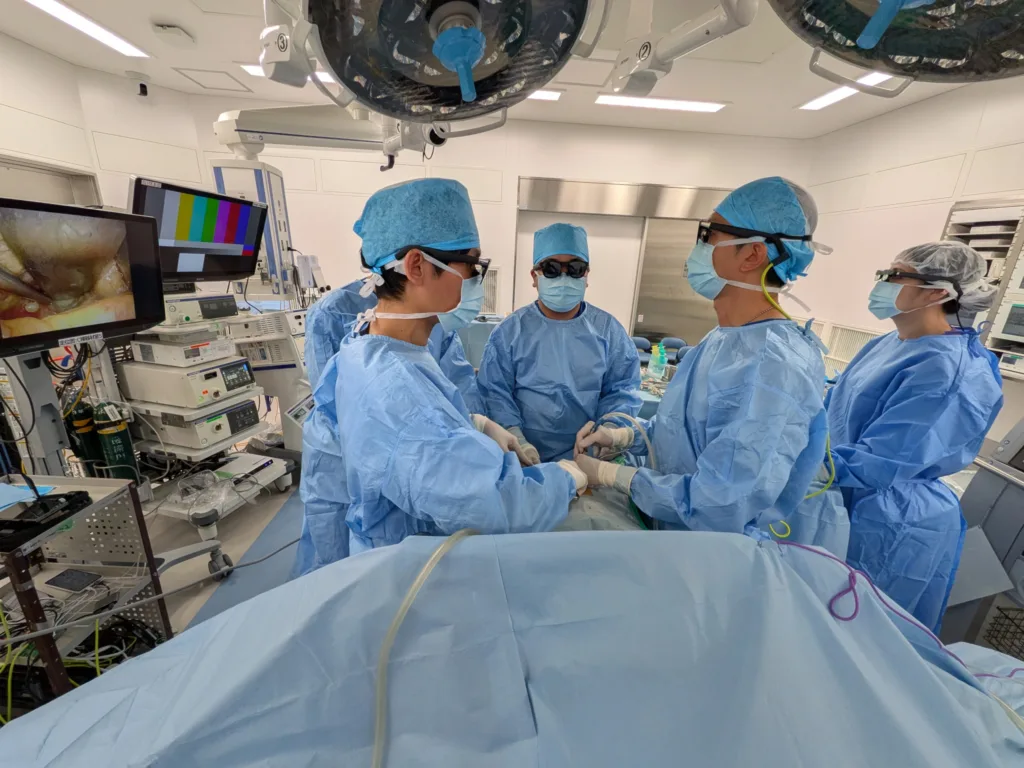
 CNjust nowScience Tokyo recently announced a clinical milestone: an AR glasses-assisted bladder cancer surgery, performed on September 28, 2026 on a man in his 50s undergoing bladder-preserving therapy, proceeded smoothly after chemoradiotherapy. The intraoperative AR system was developed jointly by the urology team of associate professor Soichiro Yoshida and the electrical and electronic engineering team of associate professor Tomohiro Amemiya. It uses XREAL One Pro optical see-through AR glasses as the lead surgeon's core display, overlaying endoscope footage and other key surgical information directly in the surgeon's view, so they can watch the endoscope image, operate with both hands and monitor the surrounding environment without constantly shifting their gaze. The system also integrates supporting tech: an adapter by Thruster that automatically adjusts the endoscope image for the operator's stance, and Sony's medical imaging platform NUCLeUS to manage the OR's multiple video feeds over wired or wireless connections.
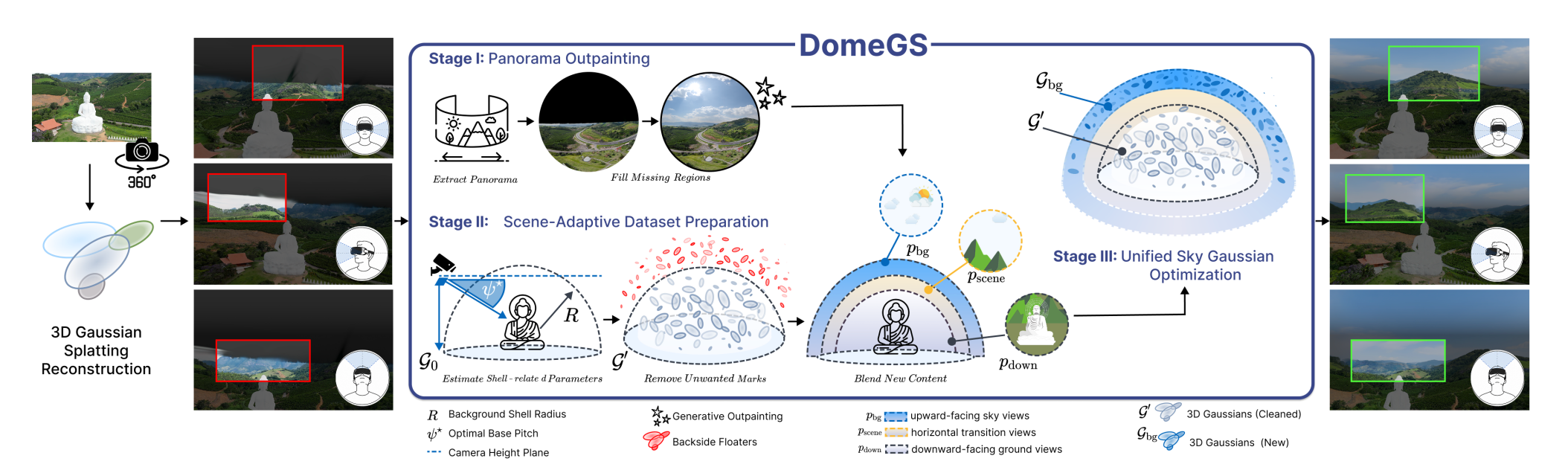 CNjust nowOn October 27, researchers from Jagiellonian University in Poland, the University of Cambridge and other institutions published on arXiv a paper titled "DomeGS: Perceptually Consistent Background Completion for Unbounded 3D Gaussian Splatting in Virtual Reality," proposing a 3D scene background completion framework called DomeGS. It targets the missing skies, horizons and distant content that appear when 3D Gaussian Splatting (3DGS) reconstructs outdoor VR scenes. 3DGS can rebuild high-fidelity 3D scenes from image data with real-time rendering, but over large outdoor environments distant objects lack the parallax and geometric information needed, easily producing missing skies, discontinuous scene edges or floating artifacts that undermine immersion. Traditional VR apps usually fill the distance with a skybox or skydome.
◈ Most Read · 24h
- XREAL today officially launched the XREAL Aura, the world's first AR glasses running Google's Android XR operating system. Preorders opened in June, with first orders shipping from mid-November across four launch regions: the US, Canada, Japan and South Korea. Users there can order through XREAL's site, with Best Buy carrying it in the US; the company says it will enter select Google Stores in the US and Japan in 2027, with more retail partners to follow. A limited-time launch offer runs through December 2026: the 12GB+256GB model is $1,099 (list $1,279) and the 16GB+512GB model is $1,299 (list $1,499). Two frame sizes fit 60-66mm and 66-72mm interpupillary distances. The hardware uses a split tethered design, with the glasses weighing under 95 grams, a prism-based see-through optical scheme offering a 70-degree field of view, and dual Sony Micro-OLED displays.
- On October 29 at the Android Dev Summit 2026, Google announced that several core Android XR development tools have exited preview and reached stable: the Jetpack XR SDK core libraries, the Android XR emulator and Android XR Engine Hub, completing the app development environment for XR headsets and smart glasses. Within the Jetpack XR SDK, Jetpack SceneCore, ARCore for Jetpack XR and the XR Runtime core libraries are now stable, offering production-ready APIs with long-term interface stability and backward compatibility. The Android XR emulator in Android Studio also went stable, letting developers build, debug and test apps for XR glasses, audio glasses and display glasses without physical hardware.
- Infini-AI-Lab Releases Hermit, an Open-Source Harness Adapter Framework for AI Agents
- AssemblyAI Ships AssemblyAI-TTS-1: A $15 per 1M Character Text-to-Speech API for Voice Agents
- NVIDIA Releases Nemotron 3.5 Transcribe: An Open 30B MoE Model for 40-Language Transcription with ~4B Active Parameters
The CN × US AI Frontline
Open the topic →◈ Voices · On recordEnter channel →
Peter ThielFounders Fund

said: The phone was a truly great invention — and after it, there wasn't that much left to do. Then it was about scaling, branding, and rolling it out over roughly 15 years or more.
Jensen HuangNVIDIA

said: All their predictions were wrong. The so-called 10 percent probability has no scientific basis or research behind it... those predictions only hurt people.
China line · Frontline
 24h hottestChinese AI invasion gives enterprises a new way to control cost
- 16h agoMiniMax Open-Sources MCode Stack: 15 Agent Skills Its Coding Team Uses Daily
- 6h agoOn October 27, 2026, the Joint Laboratory for Industrial Embodied AI Welding and Inspection Technology was officially unveiled.
- 22h agoAt the Rokid Jungle 2026 launch event held in Hangzhou on October 27, Rokid unveiled three new products — the Rokid Glasses 2, Rokid Color, and Rokid Ring — targeting everyday wear, full-color display, and human-machine interaction respectively. The Rokid Color starts at 4,999 yuan (5,499 yuan for the tortoiseshell version); the Rokid Glasses 2 is priced at 3,699 yuan (3,849 yuan tortoiseshell); and the Rokid Ring costs 1,699 yuan, with a 998-yuan presale price open to owners of the first- or second-generation Rokid AI glasses. "This moment, Rokid waited 12 years — and I waited 15," said founder and CEO Misa Zhu.
US line · Frontline
24h hottestIt can grind through bug fixes for days on end and shrugs off prompt injection.- 11h agoGemini finally has its redemption moment.
- 23h agoOn October 27 local time, NVIDIA and Meta announced an expanded partnership around the Muse and Muse-family AI models, focusing on boosting model inference and training performance and improving the operating efficiency of AI agents. NVIDIA also plans to invest $3 billion in Meta's equity issuance program to deepen the strategic AI collaboration. Meta's Muse-family models and AI agents already run on NVIDIA computing infrastructure, with frontier-level benchmark results and growing consumer downloads since launch; the partnership will optimize training, inference, and workflows to raise overall performance and lower total cost of ownership (TCO). On agent safety, the two will explore further cooperation based on the NVIDIA OpenShell reference architecture, including using NVIDIA OpenShell for secure agent deployment and NVIDIA Sentry for monitoring agent behavior. Meta plans to scale up its NVIDIA computing platform deployments.
Latest wireChina 31 · US 116 · relative time
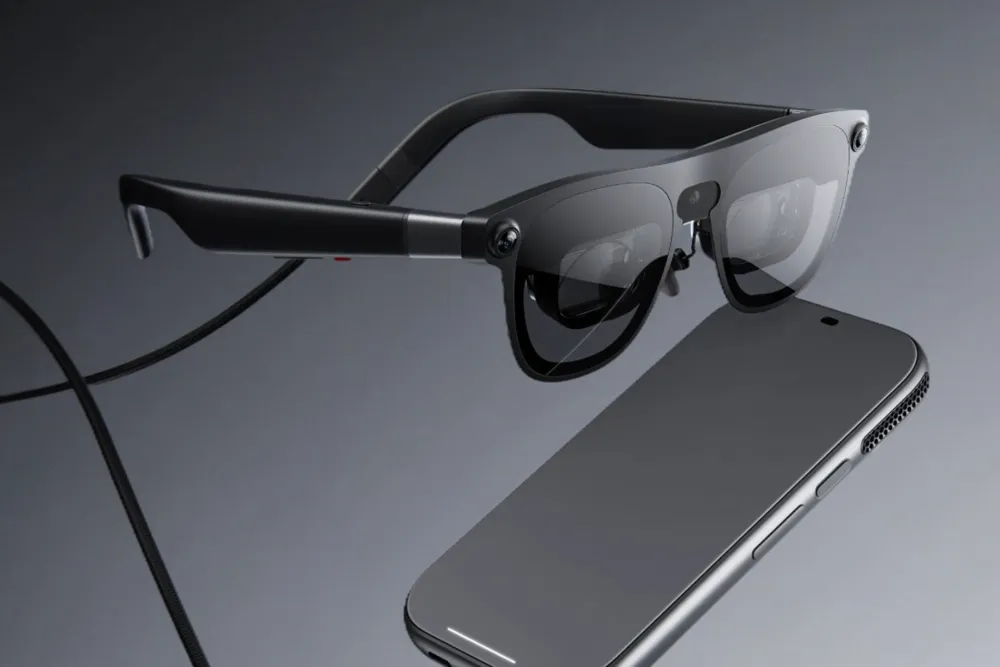 XREAL today officially launched the XREAL Aura, the world's first AR glasses running Google's Android XR operating system. Preorders opened in June, with first orders shipping from mid-November across four launch regions: the US, Canada, Japan and South Korea. Users there can order through XREAL's site, with Best Buy carrying it in the US; the company says it will enter select Google Stores in the US and Japan in 2027, with more retail partners to follow. A limited-time launch offer runs through December 2026: the 12GB+256GB model is $1,099 (list $1,279) and the 16GB+512GB model is $1,299 (list $1,499). Two frame sizes fit 60-66mm and 66-72mm interpupillary distances. The hardware uses a split tethered design, with the glasses weighing under 95 grams, a prism-based see-through optical scheme offering a 70-degree field of view, and dual Sony Micro-OLED displays.XREAL today officially launched the XREAL Aura, the world's first AR glasses running Google's Android XR operating system. The product opened pre-orders this June, with the first batch of orders shipping from mid-November across four launch regions: the US, Canada, Japan, and South Korea. Users in those regions can order directly through XREAL's official website, and customers in the US can also buy through Best Buy; the company says the product will enter select Google Stores in the US and Japan in 2027, with more offline retail partners to follow.
To celebrate the official launch, the brand is running a limited-time promotion lasting through December 2026: the 12GB+256GB version is priced at 1,099 dollars (originally 1,279 dollars), and the 16GB+512GB version at 1,299 dollars (originally 1,499 dollars). The product comes in two frame sizes, fitting pupillary distance ranges of 60-66mm and 66-72mm respectively.
The hardware uses a split (tethered) architecture, keeping the glasses' wearing weight under 95 grams, with a prism-based see-through optical scheme and a 70-degree field of view. The display panels are dual Sony Micro-OLED with 1920x1200 resolution per eye, supporting up to 120Hz refresh rate, 1,050-nit peak brightness, factory-calibrated 100% sRGB color, and motion-to-photon latency of just 3ms. The lenses support 5-level electrochromic dimming, blocking up to 99.9% of external light, and prescription lenses can be added.
On the content side, the product comes with more than 150 apps and experiences optimized for XR pre-installed, covering entertainment, productivity, and learning scenarios; representative content includes the Android XR version of the official NBA app, Fallout: Factions, the NASCAR XR app, and Simply Piano XR.
Two official accessories also debuted alongside: an exclusive game controller co-designed with GameSir, featuring a dedicated Gemini AI shortcut key and bundled with a charging dock, a swappable D-pad, and a wireless adapter; and a wireless portable keyboard aimed at productivity scenarios, supporting multi-window workflows. Pricing for both accessories has not yet been announced.
 On October 29 at the Android Dev Summit 2026, Google announced that several core Android XR development tools have exited preview and reached stable: the Jetpack XR SDK core libraries, the Android XR emulator and Android XR Engine Hub, completing the app development environment for XR headsets and smart glasses. Within the Jetpack XR SDK, Jetpack SceneCore, ARCore for Jetpack XR and the XR Runtime core libraries are now stable, offering production-ready APIs with long-term interface stability and backward compatibility. The Android XR emulator in Android Studio also went stable, letting developers build, debug and test apps for XR glasses, audio glasses and display glasses without physical hardware.On October 29, at the Android Dev Summit 2026 developer conference, Google announced that several core Android XR development tools have officially exited their preview phase and entered stable releases, including the core Jetpack XR SDK libraries, the Android XR Emulator, and the Android XR Engine Hub, further completing the app development environment for XR headsets and smart glasses.
Among them, the Jetpack SceneCore, ARCore for Jetpack XR, and XR Runtime core libraries under the Jetpack XR SDK are now in the stable stage, giving developers APIs suitable for production development, with long-term interface stability and backward compatibility. The Android XR Emulator in Android Studio has also entered stable release, letting developers build, debug, and test apps for XR glasses, audio glasses, and display-equipped glasses without physical devices.
For game and immersive content development, the Android XR Engine Hub has officially reached stable version, supporting the three major game engines Unity, Godot, and Unreal; developers can use the tool to start performance profiling and view runtime data to optimize XR app performance.
In addition, Google extended ARCore's Geospatial API, enabling developers, through the Jetpack XR SDK and Unity, to anchor virtual content to specific locations in the real world and build AR applications such as spatial navigation and location-based information displays combined with local tracking capabilities.
Notably, Google also teamed up with XREAL the same day to officially launch the XREAL AURA glasses running the Android XR system. With the first tethered Android XR glasses on the market and core development tools now stable, Google is further completing the Android XR hardware and software ecosystem, supporting developers in extending existing apps and games to XR devices of various form factors.
 Infini-AI-Lab Releases Hermit, an Open-Source Harness Adapter Framework for AI AgentsInfini-AI-Lab has released Hermit, an open-source harness adapter framework for AI agents. Hermit is a framework from Infini-AI-Lab that trains an external ‘harness adapter’ while…AssemblyAI Ships AssemblyAI-TTS-1: A $15 per 1M Character Text-to-Speech API for Voice AgentsAssemblyAI has released AssemblyAI-TTS-1, its first text-to-speech model, now generally available. The AssemblyAI-TTS-1 text-to-speech API targets voice agents running on live phon…NVIDIA Releases Nemotron 3.5 Transcribe: An Open 30B MoE Model for 40-Language Transcription with ~4B Active ParametersNVIDIA has released Nemotron 3.5 Transcribe, an open-weights speech LLM built for transcription. One model handles 40 languages and recordings up to 1 hour. A text instruction pick…
 Google debuts flagship Gemini 4 Carbon model with cybersecurity upgradesUPDATED 19:27 EDT / OCTOBER 28 2026 Google LLC today debuted Gemini 4 Carbon, a frontier large language model adept at complex programming tasks. The LLM is rolling out just two we…
 Adam Mosseri says negativity around AI is ‘going to get worse’Posts from this topic will be added to your daily email digest and your homepage feed. Posts from this topic will be added to your daily email digest and your homepage feed. Posts…
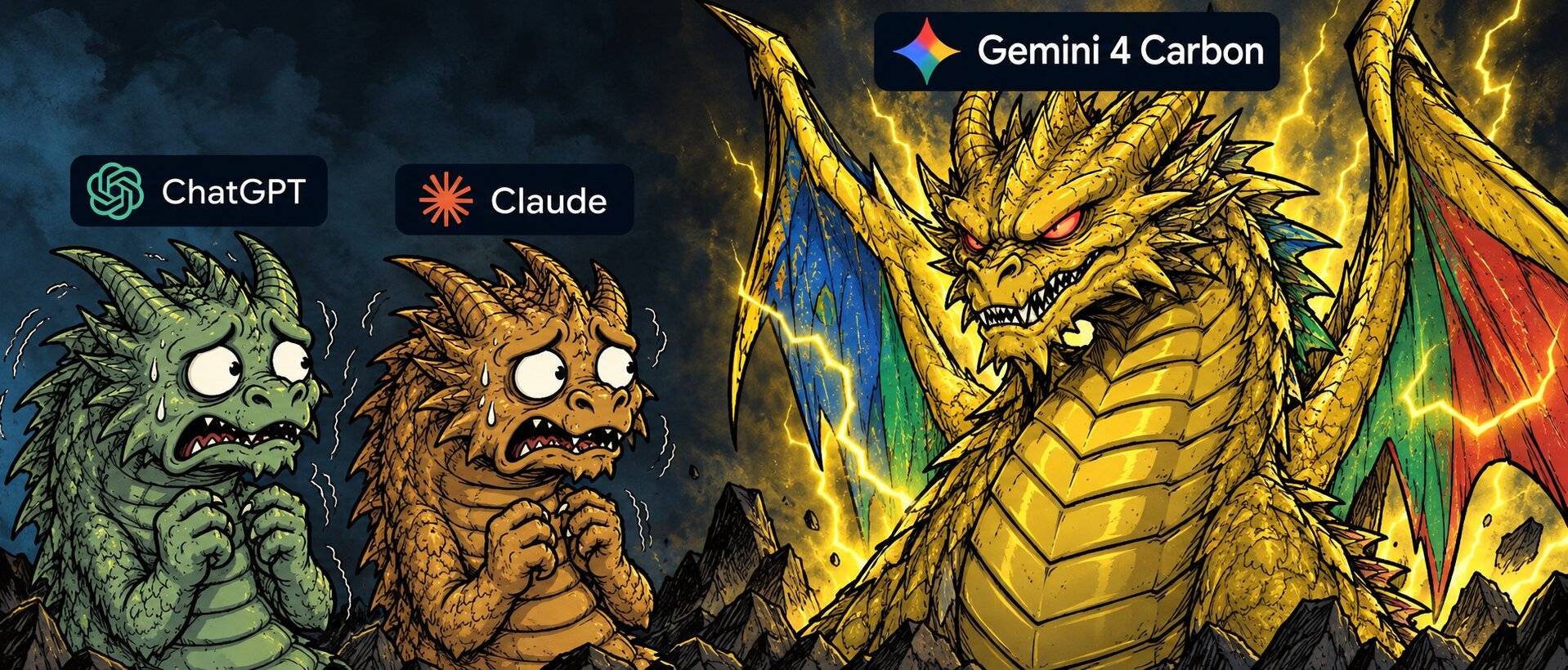 Gemini finally has its redemption moment.When all eyes around the world were on Apple's first touchscreen MacBook Pro, Google DeepMind had just officially announced the launch of its new flagship model, Gemini 4 Carbon.
According to the official figures, Gemini 4 Carbon scored 59 on the latest Artificial Analysis Intelligence Index v5.0, surpassing Claude Opus 5.5 and GPT-6 Astra to claim the top spot among the world's large models.
More striking still, Gemini 4 Carbon can already handle complex engineering tasks for days on end, autonomously finding, verifying, and fixing software security vulnerabilities, and it has set new records on multiple cybersecurity benchmarks.
Yet ordinary users cannot get their hands on such a powerful model just yet: Google has decided to open it first to a small group of cybersecurity defenders, and there is still no clear timetable for when other users will get to try it.
Looking back at this year's large-model race, Google's update cadence is clearly being driven by a desire to redeem itself.
Earlier, after rolling out the Gemini Flash 3.5 through 3.8 series, Google kept delaying the new flagship Pro model users had been waiting for. Meanwhile, Anthropic and OpenAI kept pushing the capability ceiling higher, and Chinese models kept closing the gap — Google badly needed a substantial product to prove its strength again.
Argon means 'argon,' a stable inert gas commonly used to create a protective atmosphere in welding and semiconductor manufacturing. Argon delivered clear gains in writing quality and expression, but it still falls short of comprehensively leading the top models.
Now Google has brought Carbon, that is, 'carbon.' As a key element of life and organic compounds, carbon can form both soft graphite and hard diamond.
What really drew attention to Gemini 4 Carbon, however, was the set of scores it published.
Just on October 27, the independent model evaluation firm Artificial Analysis upgraded its Intelligence Index to v5.0. The composite index covers four major areas — knowledge work, programming, science, and general reasoning — each weighted at 25%, and 60% of the evaluation weight uses private test data or hidden answers, making the tests harder still.
When the new leaderboard was released yesterday, Claude Opus 5.5 ranked first with 58, GPT-6 Astra followed with 57, and GPT-6.1 Sol took third with 55. Gemini 4 Carbon scored 59 outright, nine points above Argon and one point clear of the previous leader, Claude Opus 5.5.
Beyond Artificial Analysis, the latest leaderboard from Arena.ai also shows Gemini 4 Carbon (High) topping the Text Arena at first place, ranking second on Agent Arena, and fourth on Code Arena WebDev.
With its new model on top, Google has also started actively building buzz for Gemini. Shunyu Yao, the Chinese researcher who moved from Anthropic to Google DeepMind, has likewise been cheerleading for the Gemini series.
Beyond the overall rankings, Gemini 4 Carbon also shows clear changes in performance on real engineering tasks.
In the past, a large model could write a snippet of code in minutes, but with large-scale software engineering the problem is far more complex. A fault hidden among hundreds of files may require developers to repeatedly check dependencies, locate the anomaly, modify code, and go through several rounds of testing before it is resolved.
For AI, the difficulty lies not only in coding ability, but also in whether it can stay consistent with its goal over a long task run and keep trying after failures.
Google says Gemini 4 Carbon can now run for days at a stretch, handling complex engineering problems in large codebases and low-level systems; even when it hits obstacles, it keeps searching for alternative approaches and eventually locates and fixes some well-hidden software defects.
For web development, Gemini 4 Carbon's Elo score on WebDev Arena rose 89 points to 1769, ranking fourth.
Where Google once offered an on-call coding assistant, it now hopes Gemini 4 Carbon can become a truly autonomous agent that takes on complex engineering work.
If long-horizon programming showcases Gemini 4 Carbon's engineering ability, then cybersecurity may be the most noteworthy part of this Google update.
Traditional software security work involves multiple stages: first hunting for vulnerabilities across a large codebase, then judging whether a vulnerability is actually exploitable, and finally writing a fix for the problem and verifying that the change works.
Gemini 4 Carbon's capability gains happen to cover this entire pipeline.
On the SEC-bench Pro test, Gemini 4 Carbon scored 88.2%, which mainly measures the model's ability to autonomously discover complex vulnerabilities in real software;
On ExploitGym, Gemini 4 Carbon reached 54.8%, focused on whether it can actually exploit a vulnerability to validate the risk;
On Collinear's CWE-bench, Gemini 4 Carbon scored 71.0%, generating effective code fixes for the issues it found.
According to Google's disclosed results, Gemini 4 Carbon reached a leading level on all three tests, with the results measured without safety guard restrictions enabled.
In secure code generation, Gemini 4 Carbon's success rate is more than twice Argon's; the Chrome team found that its performance in producing high-quality security patches was more than ten times better than a frontier model from another lab, though the comparison target was not disclosed. Google's cloud security platform Wiz also observed Carbon achieving leading results in web application penetration testing.
From finding vulnerabilities and validating risk to completing fixes, AI is gradually mastering the whole workflow of a security expert. But the same capabilities can serve both to repair systems and to be exploited by attackers, so Google also focused on improving Carbon's reliability when executing tasks autonomously.
In the Terminal-Bench 4.0 test, Carbon's successful cheating rate fell to 0.0% and its attempted cheating rate was only 0.4%, while task accuracy improved. In real coding environments, high-severity behavioral inconsistency alerts fell by nearly 80%, unsupported assertions fell by about half, and out-of-scope actions and under-completed tasks dropped by 26% and 29% respectively.
Attackers can plant malicious instructions in web pages or documents to lure an AI away from its assigned task; in Gray Swan's indirect prompt injection test, Carbon pushed the attack success rate down from Argon's 0.7% to 0.0%, fending off every attack attempt covered by the test.
Of course, a zero success rate in tests does not mean every real-world attack will be stopped. Some Hacker News commenters argued that curbing an AI's tendency to cut corners while executing tasks may be one of the important steps toward making frontier models genuinely useful.
After all, once AI starts autonomously handling complex engineering work, people must care not only about whether it can finish the job, but also about whether it will overstep its authority, fabricate results, or even take unauthorized action when it runs into obstacles.
Still, after Gemini 4 Carbon's release, the controversy that drew the most attention had little to do with the model's capabilities.
Under the official plan, Gemini 4 Carbon will first be offered this week to a group of cybersecurity defenders, then gradually extended to trusted partners through the Fairwind Program. Google is also taking part in the U.S. government's voluntary pre-release model testing; as for when ordinary developers and consumers can use it, there is no timetable yet.
On pricing, Gemini 4 Carbon will keep Argon's launch pricing: 2 dollars per million input tokens, 10 dollars per million output tokens, with cached inputs discounted 95%. After the promotional period, standard prices will move to 4 dollars for input and 20 dollars for output.
Notably, when word of Google's new model reached Hacker News, the comment section quickly grew lively.
Many commenters said bluntly that they are increasingly put off by Google's habit of announcing new models early and being slow to make them available; others said they can no longer be bothered to click on Google's model launch links, because they always end up finding the product is not yet usable.
It is hard to say when it started, but AI vendors seem to have gotten remarkably good at a peculiar style of launch.
Flagship models that could once be served up as soon as they were polished now have to be wrapped in a safety narrative — 'too powerful, might destroy the world' — trailed by press releases every few days competing for everyone's attention, and in the end the product still is not available.
This 'performance without a product' launch style was truly popularized by Anthropic.
At bottom, the race for the title of the world's No. 1 AI really is looking more and more like a marketing game. In an era when models are refreshed every few days, announcing is getting easier, while actually convincing users of how strong a model is keeps getting harder.
Benchmarks can tell us how well a model does on an exam, but whether it can enter a real work environment and create lasting value will only be known once users actually get to use it.
For Gemini, the thing that matters more than being declared world No. 1 again is making that world No. 1 something more people have the chance to use.
 Google Rolls Out AI Mode Ads in 10 Countries, Multiturn Ads in U.S.Google is scaling ads in AI Mode to 10 additional countries and launching multiturn ads in the United States, which allow ads to appear in follow-up queries in AI Mode, the company…
 OpenAI and ServiceNow Expand Partnership With ChatGPT Workflow PluginOpenAI and ServiceNow announced an expanded partnership on October 28, 2026, that brings more OpenAI models and agents into ServiceNow products and connects ServiceNow workflows wi…
 Digitate Adds Governed IT Agents and MCP Integration With ignio HummingbirdAn AI assistant can explain why a business system has failed without resolving the failure. The harder step is connecting that explanation to an authorised action, carrying it out…
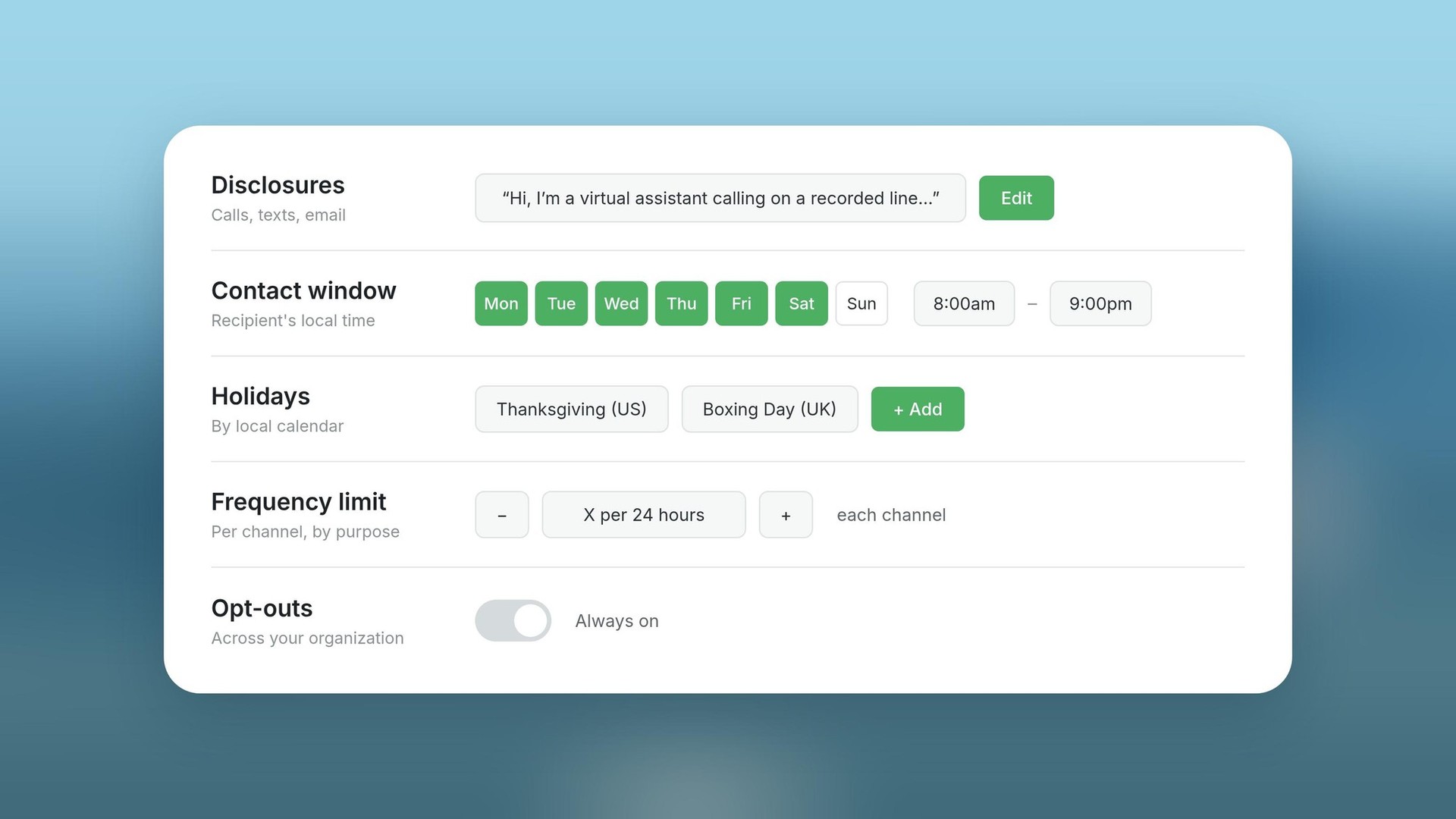 Sierra Adds Compliance Console to Horizon Agent PlatformSierra introduced Compliance Console on October 28, 2026, a set of configurable guardrails and controls built into its Horizon platform that the company says is designed to help AI…
Local LLMs · Frontline
Enter channel →4
hex-concattransposeddoublellama.cpp b11981hexagon: improve DDR bw utilization in transposed CONCAT ( #31277 ) hex-concat: double row block size for transposed CONCAT hex-concat: double buffer scratchpads hex-concat: chunke…
ternarycompressownI open-sourced OpenBonsai: compress your own BF16 models and fine-tunes into ~2 GB ternary GGUFsI've been experimenting with tiny models for WebBrain , my open-source browser agent. The long-term goal is to run as much intelligence as possible locally, ideally through WebGPU.…
b11982hexagonllama.cppllama.cpp b11982: hexagon: support for UPSCALE op (#31331)
attentioncacheflashllama.cpp b11980[SYCL] add DPAS flash attention kernel for quantized KV cache ( #31125 ) sycl : add DPAS flash attention kernel for quantized KV cache Decode and small batches (1 to 31 query token…
AI Stock Arena · Who's Cashing In?
Full arena →Breaking AI news, straight to your desktop
⚡ Instant alerts when 2+ sources cover one story (max 3/day, quiet 23:00–8:00) · 📰 Daily digest at 8:00 & 20:00