Gemini finally has its redemption moment.
When all eyes around the world were on Apple's first touchscreen MacBook Pro, Google DeepMind had just officially announced the launch of its new flagship model, Gemini 4 Carbon. According to the official figures, Gemini 4 Carbon scored 59 on the latest Artificial Analysis Intelligence Index v5.0, surpassing Claude Opus 5.5 and GPT-6 Astra to claim the top spot among the world's large models. More striking still, Gemini 4 Carbon can already handle complex engineering tasks for days on end, autonomously finding, verifying, and fixing software security vulnerabilities, and it has set new records on multiple cybersecurity benchmarks. Yet ordinary users cannot get their hands on such a powerful model just yet: Google has decided to open it first to a small group of cybersecurity defenders, and there is still no clear timetable for when other users will get to try it. Looking back at this year's large-model race, Google's update cadence is clearly being driven by a desire to redeem itself. Earlier, after rolling out the Gemini Flash 3.5 through 3.8 series, Google kept delaying the new flagship Pro model users had been waiting for. Meanwhile, Anthropic and OpenAI kept pushing the capability ceiling higher, and Chinese models kept closing the gap — Google badly needed a substantial product to prove its strength again. Argon means 'argon,' a stable inert gas commonly used to create a protective atmosphere in welding and semiconductor manufacturing. Argon delivered clear gains in writing quality and expression, but it still falls short of comprehensively leading the top models. Now Google has brought Carbon, that is, 'carbon.' As a key element of life and organic compounds, carbon can form both soft graphite and hard diamond. What really drew attention to Gemini 4 Carbon, however, was the set of scores it published. Just on October 27, the independent model evaluation firm Artificial Analysis upgraded its Intelligence Index to v5.0. The composite index covers four major areas — knowledge work, programming, science, and general reasoning — each weighted at 25%, and 60% of the evaluation weight uses private test data or hidden answers, making the tests harder still. When the new leaderboard was released yesterday, Claude Opus 5.5 ranked first with 58, GPT-6 Astra followed with 57, and GPT-6.1 Sol took third with 55. Gemini 4 Carbon scored 59 outright, nine points above Argon and one point clear of the previous leader, Claude Opus 5.5. Beyond Artificial Analysis, the latest leaderboard from Arena.ai also shows Gemini 4 Carbon (High) topping the Text Arena at first place, ranking second on Agent Arena, and fourth on Code Arena WebDev. With its new model on top, Google has also started actively building buzz for Gemini. Shunyu Yao, the Chinese researcher who moved from Anthropic to Google DeepMind, has likewise been cheerleading for the Gemini series. Beyond the overall rankings, Gemini 4 Carbon also shows clear changes in performance on real engineering tasks. In the past, a large model could write a snippet of code in minutes, but with large-scale software engineering the problem is far more complex. A fault hidden among hundreds of files may require developers to repeatedly check dependencies, locate the anomaly, modify code, and go through several rounds of testing before it is resolved. For AI, the difficulty lies not only in coding ability, but also in whether it can stay consistent with its goal over a long task run and keep trying after failures. Google says Gemini 4 Carbon can now run for days at a stretch, handling complex engineering problems in large codebases and low-level systems; even when it hits obstacles, it keeps searching for alternative approaches and eventually locates and fixes some well-hidden software defects. For web development, Gemini 4 Carbon's Elo score on WebDev Arena rose 89 points to 1769, ranking fourth. Where Google once offered an on-call coding assistant, it now hopes Gemini 4 Carbon can become a truly autonomous agent that takes on complex engineering work. If long-horizon programming showcases Gemini 4 Carbon's engineering ability, then cybersecurity may be the most noteworthy part of this Google update. Traditional software security work involves multiple stages: first hunting for vulnerabilities across a large codebase, then judging whether a vulnerability is actually exploitable, and finally writing a fix for the problem and verifying that the change works. Gemini 4 Carbon's capability gains happen to cover this entire pipeline. On the SEC-bench Pro test, Gemini 4 Carbon scored 88.2%, which mainly measures the model's ability to autonomously discover complex vulnerabilities in real software; On ExploitGym, Gemini 4 Carbon reached 54.8%, focused on whether it can actually exploit a vulnerability to validate the risk; On Collinear's CWE-bench, Gemini 4 Carbon scored 71.0%, generating effective code fixes for the issues it found. According to Google's disclosed results, Gemini 4 Carbon reached a leading level on all three tests, with the results measured without safety guard restrictions enabled. In secure code generation, Gemini 4 Carbon's success rate is more than twice Argon's; the Chrome team found that its performance in producing high-quality security patches was more than ten times better than a frontier model from another lab, though the comparison target was not disclosed. Google's cloud security platform Wiz also observed Carbon achieving leading results in web application penetration testing. From finding vulnerabilities and validating risk to completing fixes, AI is gradually mastering the whole workflow of a security expert. But the same capabilities can serve both to repair systems and to be exploited by attackers, so Google also focused on improving Carbon's reliability when executing tasks autonomously. In the Terminal-Bench 4.0 test, Carbon's successful cheating rate fell to 0.0% and its attempted cheating rate was only 0.4%, while task accuracy improved. In real coding environments, high-severity behavioral inconsistency alerts fell by nearly 80%, unsupported assertions fell by about half, and out-of-scope actions and under-completed tasks dropped by 26% and 29% respectively. Attackers can plant malicious instructions in web pages or documents to lure an AI away from its assigned task; in Gray Swan's indirect prompt injection test, Carbon pushed the attack success rate down from Argon's 0.7% to 0.0%, fending off every attack attempt covered by the test. Of course, a zero success rate in tests does not mean every real-world attack will be stopped. Some Hacker News commenters argued that curbing an AI's tendency to cut corners while executing tasks may be one of the important steps toward making frontier models genuinely useful. After all, once AI starts autonomously handling complex engineering work, people must care not only about whether it can finish the job, but also about whether it will overstep its authority, fabricate results, or even take unauthorized action when it runs into obstacles. Still, after Gemini 4 Carbon's release, the controversy that drew the most attention had little to do with the model's capabilities. Under the official plan, Gemini 4 Carbon will first be offered this week to a group of cybersecurity defenders, then gradually extended to trusted partners through the Fairwind Program. Google is also taking part in the U.S. government's voluntary pre-release model testing; as for when ordinary developers and consumers can use it, there is no timetable yet. On pricing, Gemini 4 Carbon will keep Argon's launch pricing: 2 dollars per million input tokens, 10 dollars per million output tokens, with cached inputs discounted 95%. After the promotional period, standard prices will move to 4 dollars for input and 20 dollars for output. Notably, when word of Google's new model reached Hacker News, the comment section quickly grew lively. Many commenters said bluntly that they are increasingly put off by Google's habit of announcing new models early and being slow to make them available; others said they can no longer be bothered to click on Google's model launch links, because they always end up finding the product is not yet usable. It is hard to say when it started, but AI vendors seem to have gotten remarkably good at a peculiar style of launch. Flagship models that could once be served up as soon as they were polished now have to be wrapped in a safety narrative — 'too powerful, might destroy the world' — trailed by press releases every few days competing for everyone's attention, and in the end the product still is not available. This 'performance without a product' launch style was truly popularized by Anthropic. At bottom, the race for the title of the world's No. 1 AI really is looking more and more like a marketing game. In an era when models are refreshed every few days, announcing is getting easier, while actually convincing users of how strong a model is keeps getting harder. Benchmarks can tell us how well a model does on an exam, but whether it can enter a real work environment and create lasting value will only be known once users actually get to use it. For Gemini, the thing that matters more than being declared world No. 1 again is making that world No. 1 something more people have the chance to use.
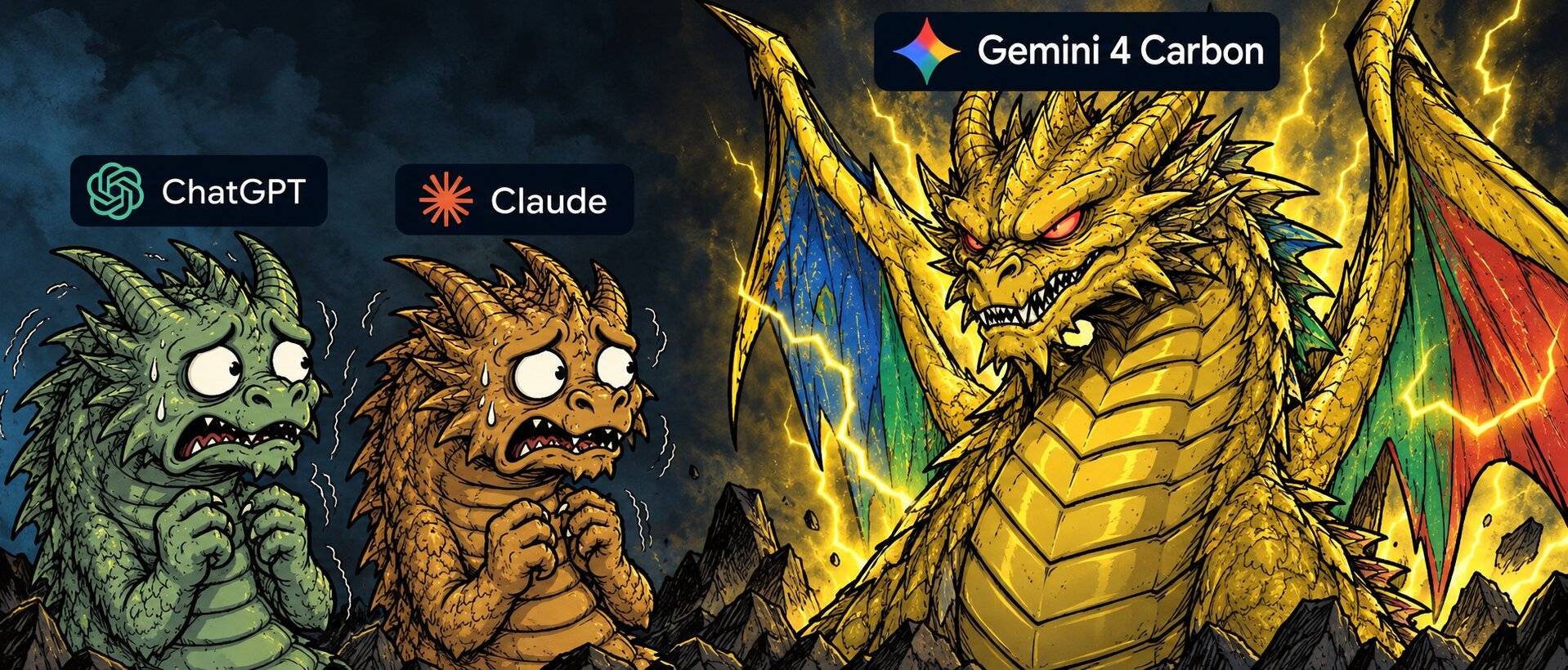
当全世界的目光都聚焦在苹果首款触控屏 MacBook Pro 身上,Google DeepMind 刚刚正式宣布推出新一代旗舰模型 Gemini 4 Carbon。
按照官方公布的数据,Gemini 4 Carbon 在最新 Artificial Analysis Intelligence Index v5.0 榜单中拿下 59 分,超越 Claude Opus 5.5 和 GPT-6 Astra,登上全球大模型榜首。
更惊人的是,Gemini 4 Carbon 已经能连续数天处理复杂工程任务,自主寻找、验证并修复软件安全漏洞,在多项网络安全基准测试中刷新纪录。
然而,如此强大的模型,普通用户暂时还用不上:谷歌决定优先向少数网络安全防御人员开放,其他用户何时能够体验仍没有明确时间表。
回顾今年的大模型竞争,谷歌的更新节奏明显正在「知耻而后勇」。
此前,接连推出 Gemini Flash 3.5 至 3.8 系列后,谷歌迟迟没有兑现新一代旗舰 Pro 模型的期待。另一边,Anthropic 和 OpenAI 持续刷新能力上限,国产模型也在不断追赶,谷歌急需一款有分量的产品重新证明自己的实力。
Argon 意为「氩」,是一种性质稳定的惰性气体,常用于焊接和半导体制造中的保护环境。Argon 在文笔写作、表达质量等方面取得了明显提升,但距离全面领先顶级模型仍有差距。
如今,谷歌又带来了 Carbon,也就是「碳」。作为构成生命与有机化合物的重要元素,碳既能形成柔软的石墨,也能构成坚硬的金刚石。
真正让 Gemini 4 Carbon 引起关注的,还是它公布的一系列成绩。
就在 10 月 27 日,独立模型评测机构 Artificial Analysis 刚刚升级了 Intelligence Index v5.0。这套综合指数涵盖知识工作、编程、科学和通用推理四大领域,各占 25%,其中 60% 的评测权重采用私有测试数据或隐藏答案,进一步提高了测试难度。
昨天新版榜单发布时,Claude Opus 5.5 以 58 分排名第一,GPT-6 Astra 以 57 分紧随其后,GPT-6.1 Sol 则以 55 分位居第三。而 Gemini 4 Carbon 直接拿到了 59 分,比 Argon 高出 9 分,也以 1 分优势超过此前榜首的 Claude Opus 5.5。
不止 Artificial Analysis,Arena.ai 最新公布的榜单也显示,Gemini 4 Carbon(High)在 Text Arena 登顶第一、Agent Arena 排名第二、Code Arena WebDev 排名第四。
伴随着新模型登顶,谷歌内部也开始为 Gemini 积极造势。此前从 Anthropic 跳槽至 Google DeepMind 的华人研究员姚顺宇,同样为 Gemini 系列宣传打 call。
除了综合排名,Gemini 4 Carbon 在实际工程任务上的表现也有明显变化。
过去,大模型可以在几分钟内写出一段程序,但面对大型软件工程,问题就复杂得多。一个隐藏在数百个文件中的故障,可能需要开发者反复检查依赖关系、定位异常、修改代码,再经过多轮测试才能解决。
对于 AI 而言,难点除了编程能力,还有能否在长时间执行任务的过程中保持目标一致,并在失败之后继续尝试。
谷歌表示,Gemini 4 Carbon 已经能够连续运行数天,处理大型代码库和底层系统中的复杂工程问题,即使遇到障碍,也能持续寻找其他方案,最终定位并修复一些隐蔽的软件缺陷。
网页开发方面,Gemini 4 Carbon 在 WebDev Arena 上的 Elo 评分提升了 89 分,达到 1769 分,排名第四。
相比过去随叫随到的编程助手,谷歌希望 Gemini 4 Carbon 能够成为真正承担复杂工程任务的自主 Agent。
如果说长程编程体现了 Gemini 4 Carbon 的工程能力,那么网络安全,可能才是谷歌此次更新最值得关注的部分。
传统的软件安全工作需要经历多个环节,首先从大量代码中寻找漏洞,再判断漏洞是否真的可以利用,最后针对问题编写修复程序,并验证修改是否有效。
Gemini 4 Carbon 的能力提升,恰好覆盖了这条完整流程。
在 SEC-bench Pro 测试中,Gemini 4 Carbon 取得了 88.2% 的成绩,主要考察模型在真实软件中自主发现复杂漏洞的能力;
在 ExploitGym 测试中,Gemini 4 Carbon 达到 54.8%,重点考察能否实际利用漏洞来验证风险;
在 Collinear 的 CWE-bench 测试中,Gemini 4 Carbon 又取得 71.0%,能够针对发现的问题生成有效的代码修复方案。
按照谷歌披露的结果,Gemini 4 Carbon 在上述三项测试中均达到了领先水平,相关成绩是在未启用安全防护限制的条件下测得。
在安全代码生成方面,Gemini 4 Carbon 的成功率超过 Argon 的两倍;Chrome 团队发现,其生成高质量安全补丁的表现比另一家实验室的前沿模型高出十倍以上,但未披露对比对象。谷歌旗下云安全平台 Wiz 也观察到,Carbon 在网络应用渗透测试中取得领先成绩。
从发现漏洞、验证风险到完成修复,AI 正在逐渐掌握网络安全专家的一整套工作流程。但同样的能力既能用于修复系统,也可能被攻击者利用,因此,谷歌还重点提升了 Carbon 在自主执行任务时的可靠性。
在 Terminal-Bench 4.0 测试中,Carbon 成功作弊的比例降至 0.0%,尝试作弊的比例仅为 0.4%,同时任务准确率有所提升。在实际编程环境中,高严重程度的行为不一致警报减少近 80%,缺乏证据支持的断言减少约一半,越权行动和未充分完成任务的情况也分别下降 26% 和 29%。
攻击者可能在网页或文档中植入恶意指令,诱导 AI 偏离原本任务,而在 Gray Swan 的间接提示词注入测试中,Carbon 将攻击成功率从 Argon 的 0.7% 进一步降至 0.0%,抵御了此次测试覆盖的全部攻击尝试。
当然,测试中的零成功率并不意味着现实中的所有攻击都能被阻止。有 Hacker News 网友认为,减少 AI 在执行任务时投机取巧,可能是提升前沿模型实用性的重要进步之一。
毕竟,当 AI 开始自主处理复杂工程任务,人们除了关心它能否完成工作,还必须考虑它会不会越权操作、编造结果,甚至在遇到障碍时擅自行动。
不过,Gemini 4 Carbon 发布后,最引人关注的争议,反而和模型能力没有太大关系。
按照官方安排,Gemini 4 Carbon 本周将首先提供给部分网络安全防御人员,再通过 Fairwind Program 逐步扩大至可信合作伙伴。谷歌还在参与美国政府自愿开展的模型发布前测试,至于普通开发者和消费者何时能够使用,暂时没有时间表。
价格方面,Gemini 4 Carbon 将沿用 Argon 的首发定价,每百万输入 Token 收费 2 美元,输出 Token 收费 10 美元,缓存输入优惠 95%。推广期结束后,标准价格将调整为输入 4 美元、输出 20 美元。
值得一提的是,谷歌发布新模型的消息传到 Hacker News,评论区很快热闹起来。
不少网友直言,自己越来越反感谷歌提前宣布新模型、却迟迟不开放的做法;也有网友表示,已经懒得点开谷歌的模型发布链接,因为最后总会发现产品暂时用不上。
不知道从什么时候开始,AI 厂商们似乎越来越擅长一种奇特的发布方式。
原本等打磨好就能直接端上桌的旗舰模型,现在非要套上一层能力太强怕毁灭世界的安全叙事外壳,隔三差五发篇通稿围猎大伙的注意力,结果到头来却迟迟用不上。
这种「无实物表演」的发布方式属实是被 Anthropic 带到沟里去了。
归根结底,争抢全球第一 AI 头衔的竞争,也确实越来越像一场营销游戏。在一个模型几乎每隔几天就会刷新的时代,发布越来越容易,真正让用户相信它有多强,反而越来越难。
毕竟,Benchmark 可以告诉我们模型在考试中有多厉害,但能否进入真实的工作环境、创造持续的价值,还得等用户真正用上它之后才知道。
而对于 Gemini 来说,或许比再次宣布全球第一更重要的事情,是尽快让这个全球第一让更多人有机会用上。
版权所有 © 广州利沃致远投资管理合伙企业(有限合伙) 2008 - 2026。以商业目的使用爱范儿网站内容需获许可。非商业目的使用授权遵循 CC BY-NC 4.0。
All content is made available under the CC BY-NC 4.0 for non-commercial use. Commercial use of this content is prohibited without explicit permission.