On October 27, researchers from Jagiellonian University in Poland, the University of Cambridge and other institutions published on arXiv a paper titled "DomeGS: Perceptually Consistent Background Completion for Unbounded 3D Gaussian Splatting in Virtual Reality," proposing a 3D scene background completion framework called DomeGS. It targets the missing skies, horizons and distant content that appear when 3D Gaussian Splatting (3DGS) reconstructs outdoor VR scenes. 3DGS can rebuild high-fidelity 3D scenes from image data with real-time rendering, but over large outdoor environments distant objects lack the parallax and geometric information needed, easily producing missing skies, discontinuous scene edges or floating artifacts that undermine immersion. Traditional VR apps usually fill the distance with a skybox or skydome.
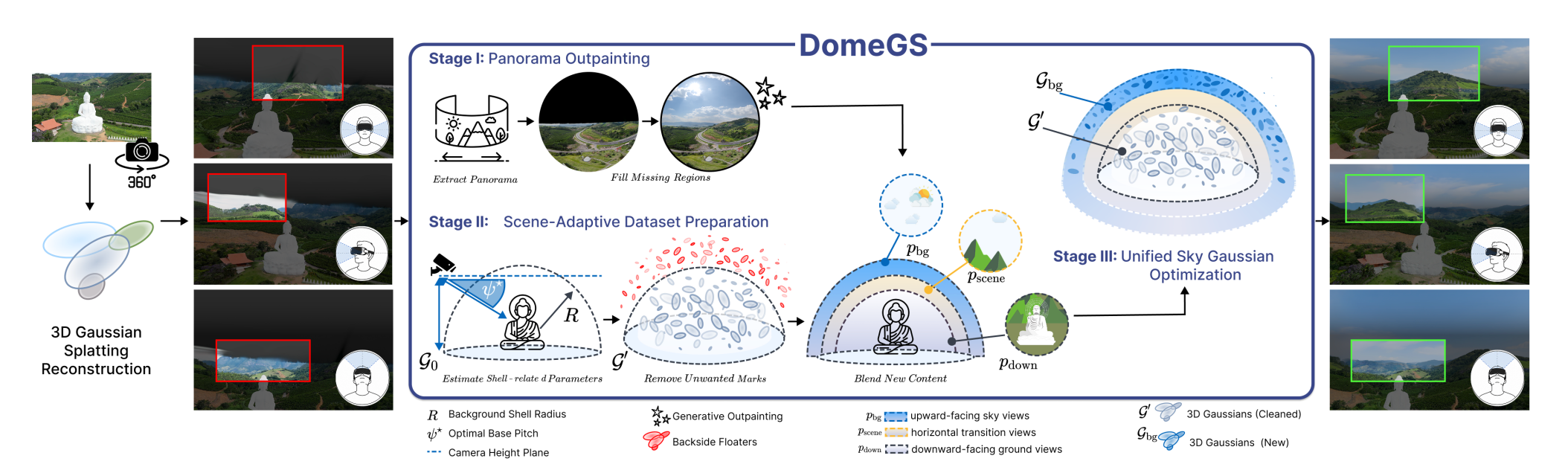
Compiled by VR Gyro On October 27, researchers from institutions including Jagiellonian University in Poland and the University of Cambridge in the UK published a paper on arXiv titled "DomeGS: Perceptually Consistent Background Completion for Unbounded 3D Gaussian Splatting in Virtual Reality," proposing a 3D scene background completion framework called DomeGS. It aims to solve the problem of missing sky, horizon, and distant-view content when 3D Gaussian Splatting (3DGS) reconstructs outdoor VR scenes. Reportedly, 3DGS can reconstruct high-fidelity 3D scenes from image data and supports real-time rendering. However, when reconstructing large outdoor environments, distant objects lack sufficient parallax and geometric information, which easily leads to problems such as missing skies, discontinuous scene edges, or floating artifacts, undermining users' immersive experience in VR. Traditional VR applications usually fill the distance with a skybox or skydome, but such standalone background solutions may differ from the near scene reconstructed by 3DGS in color, lighting, and perspective, and seams in the picture are especially easy to expose when users move their viewpoint. To address this limitation, the research team proposed the DomeGS framework, which combines generative background completion with 3DGS scene reconstruction so that the sky and distant view directly become part of a unified 3D scene. On the technical side, DomeGS first extracts a panoramic image from the existing 3DGS scene and uses a generative model to complete the missing sky and distant content; it then generates new multi-view training data based on the scene's geometric structure, adds and optimizes Gaussian primitives within a spherical region of limited radius, and finally fuses the completed background with the original 3D scene. Unlike a traditional skybox, DomeGS can present motion parallax more consistent with spatial depth relationships as users move, while improving visual continuity between near and far scenes and reducing problems such as background seams and lighting inconsistency. In experiments, the research team recruited 36 participants, tested four groups of outdoor scenes using Meta Quest Pro headsets, and compared the experience of DomeGS against a traditional skybox solution. The results showed that DomeGS achieved statistically significant improvements on both spatial presence and perceived realism (p=0.042). In the subjective preference survey, 75% of participants said they would prefer to stay for a long time in a virtual environment using DomeGS, and 69.4% considered it better suited for panoramic scene viewing. In addition, the two solutions showed no notable differences in task completion time, head movement distance, or VR cybersickness symptom scores, indicating that while DomeGS improves scene realism, it did not bring a significantly increased operational burden or discomfort in this experiment. The research team believes that DomeGS offers a new technical path for background completion of outdoor 3DGS scenes and can help improve the quality of VR content built on real-environment reconstruction. However, the work is still at the research stage, and its performance in more complex scenes and real applications remains to be further verified. Source: arXiv
编译/VR陀螺 10月27日,来自波兰雅盖隆大学、英国剑桥大学等机构的研究人员在arXiv发表论文《DomeGS: Perceptually Consistent Background Completion for Unbounded 3D Gaussian Splatting in Virtual Reality》,提出一种名为DomeGS的三维场景背景补全框架,旨在解决3D高斯泼溅(3D Gaussian Splatting,3DGS)重建户外VR场景时,天空、地平线及远景内容缺失的问题。
据了解,3DGS能够利用图像数据重建高保真三维场景,并支持实时渲染,但在重建大范围户外环境时,由于远处物体缺少足够的视差及几何信息,容易出现天空缺失、场景边缘不连续或悬浮伪影等问题,影响用户在VR环境中的沉浸体验。传统VR应用通常采用天空盒(Skybox)或天空穹顶(Skydome)填充远景,但这类独立背景方案可能与3DGS重建的近景产生颜色、光照及透视差异,在用户移动视角时尤其容易暴露画面衔接问题。
针对这一局限,研究团队提出DomeGS框架,将生成式背景补全与3DGS场景重建相结合,使天空及远景直接成为统一三维场景的一部分。技术方面,DomeGS首先从已有3DGS场景提取全景图像,利用生成模型补全缺失的天空及远景内容;随后根据场景几何结构生成新的多视角训练数据,并在有限半径的球形区域内添加和优化高斯基元,最终将补全背景与原有三维场景融合。与传统天空盒不同,DomeGS能够在用户移动时呈现更符合空间深度关系的运动视差,同时改善远近景之间的视觉连续性,减少背景接缝及光照不一致等问题。
实验方面,研究团队招募36名参与者,使用Meta Quest Pro头显对四组户外场景进行测试,并比较DomeGS与传统天空盒方案的体验差异。结果显示,DomeGS在空间临场感和感知真实感两项指标上均取得具有统计学显著性的提升(p=0.042)。在主观偏好调查中,75%的参与者表示更愿意在采用DomeGS的虚拟环境中长时间停留,69.4%的参与者认为其更适合全景场景观看。此外,两种方案在任务完成时间、头部移动距离及VR眩晕症状评分方面未呈现明显差异,表明DomeGS在提升场景真实感的同时,没有在本次实验中带来显著增加的操作负担或不适感。
研究团队认为,DomeGS为3DGS户外场景的背景补全提供了一种新的技术路径,有助于改善基于真实环境重建的VR内容质量。不过,目前相关成果仍处于研究阶段,其在更复杂场景及实际应用中的表现仍有待进一步验证。来源: arXiv